

Surgery to remove or treat an abnormal tangle of blood vessels in the brain.
Overview
What is a brain AVM?
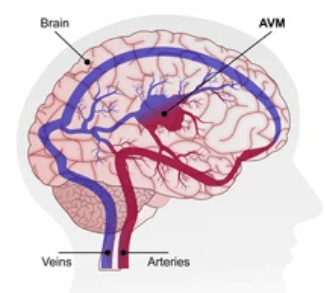
- A brain arteriovenous malformation (AVM) is an abnormal tangle of blood vessels in the brain
- The tangle is made of blood vessels that would normally carry blood to (arteries) and from the brain (veins)
- Normally, blood flows through blood vessels in an organised way
- Tiny blood vessels called capillaries connect the vessels that bring blood to the brain with those that take it away
- In an AVM, these tiny connecting vessels are missing
- The blood vessels (arteries and veins) connect directly and abnormally, which can affect blood flow and increase the risk of bleeding in the brain
What causes an AVM?
The exact cause is not always known. Most AVMs are present from birth, may be inherited in rare cases.
Symptoms of a brain AVM
Some AVMs do not cause symptoms. Others may cause:
Headaches
Seizures
Weakness or numbness
Problems with speech
Dizziness
Vision problems
Bleeding in the brain
A sudden severe headache or collapse may be a sign of bleeding and needs urgent medical attention.
What tests are used to diagnose an AVM?
Doctors may use scans and imaging tests to look at the blood vessels in the brain.
Common tests include:
- Magnetic resonance imaging (MRI) scan – uses magnets and radio waves to create detailed pictures of the brain
- Computed tomography (CT) scan – uses X-rays to create detailed images of the brain
- Angiography – a thin tube is placed into a blood vessel and dye is used to show blood vessels clearly
- MRA or CTA scans – special scans that show blood vessels in more detail
- Ultrasound scan – uses sound waves to check blood flow in the brain
Sometimes, an AVM is found during scans done for headaches, vision problems or after bleeding in the brain.
How is an AVM treated?
Treatment depends on the size and location of the AVM and symptoms
Medicines
Medicines may help control symptoms such as:
- Seizures (fits)
- Headaches
- High blood pressure
Procedures
- Surgery: The surgeon removes the AVM to reduce the risk of bleeding
- Embolisation: A thin tube is used to inject a special substance into the AVM to reduce or stop blood flow
- Radiosurgery (Gamma Knife®): Focused radiation is used to slowly shrink the AVM over time
Your doctor will explain which treatment is best for you.
What is AVM surgery?
AVM surgery aims to remove the abnormal blood vessels and reduce the risk of bleeding.Surgery is often a cure for this condition.
Before surgery
Before the operation:
- Blood tests and brain scans may be performed
- Blood pressure, pulse and temperature may be checked
- Tell your doctor about medicines and allergies
- You may need to stop eating and drinking several hours before surgery
What happens during AVM surgery?
Step-by-step overview:
- You will receive general anaesthesia, so you will be asleep
- A small part of the scalp may be shaved
- The surgeon makes an opening in the skull, called a craniotomy
- Special microscopes and tools are used to find the AVM
- The surgeon seals the nearby blood vessels to help prevent bleeding
- The AVM is carefully removed
- Blood is redirected through normal blood vessels
- The skull bone is replaced and secured
- The wound is closed with stitches or staples
The operation time depends on the size and location of the AVM. After surgery, you may need a brain scan, a short hospital stay and some rehabilitation. Surgery may cure the condition if the AVM is completely removed.
Recovery after surgery
- Most people stay in hospital for several days
- Tiredness and headaches are common for a few weeks
- Some people may need physiotherapy or speech therapy
- Full recovery can take weeks to months
At home, you may be advised to:
- Get plenty of rest
- Avoid heavy lifting
- Take medicines as prescribed
- Attend follow-up appointments
- Avoid smoking and excessive alcohol
Benefits and risks of AVM surgery
Benefits
- Reduces the risk of bleeding in the brain
- Can improve symptoms such as seizures or headaches
- May completely remove the AVM
Risks
All surgery carries some risks. Possible complications include:
- Infection
- Bleeding
- Stroke
- Seizures
- Weakness or speech problems
- Memory or thinking difficulties
Your surgeon will explain the risks and benefits for your condition.
Warning signs (Red flags)
Get urgent medical help immediately if you notice:
- A sudden severe headache
- Seizures (fits)
- Weakness in the arms or legs
- Problems with vision or balance
- Confusion or memory problems
These may be signs of bleeding in the brain and can be life-threatening.
Lifestyle advice after surgery
- Stop smoking if you smoke
- Keep blood pressure under control
- Eat a healthy balanced diet
- Exercise regularly as advised by your doctor
- Avoid illegal drugs
- Attend all follow-up appointments
- Driving: Ask your doctor when it is safe to drive again after surgery

Myths & Facts
All AVMs cause symptoms.
Some AVMs may not cause any symptoms and are only found during a scan for another problem.
All AVMs bleed.
Not all AVMs bleed. Some people may never have bleeding or health problems.
AVM surgery is always dangerous.
AVM surgery is carefully planned and may reduce the risk of future bleeding.
Recovery after surgery is immediate.
Recovery may take weeks or months depending on the size and location of the AVM.
Headaches always mean an AVM is bleeding.
Headaches can happen for many reasons, but a sudden severe headache needs urgent medical help.
Frequently Asked Questions
Are AVMs dangerous?
They can be. The main risk is bleeding in the brain. A sudden severe headache can be a sign of bleeding and needs urgent medical help.
Do all AVMs bleed?
No. Some AVMs never cause symptoms or problems and may only be found during a scan for another reason.
Can an AVM be cured?
Surgery may cure the condition if the AVM is completely removed.
How long is recovery after surgery?
Recovery may take weeks to months. Some people may need rehabilitation or therapy.
Can AVMs affect children?
Yes. Some children may develop learning or behavioural problems.
When should I seek urgent medical help?
Get urgent help for sudden severe headache, seizures, weakness, confusion or vision problems.
Speak to a neurology specialist
Get an expert opinion and a personalised treatment plan at Sterling Hospitals.